Green and amber LED light appear often in at-home beauty devices, usually with promises around pigmentation, calmness and radiance. The published evidence, however, points most consistently towards red and near-infrared light for these skincare concerns, with blue light being well established for clearing breakouts, hormonal breakouts and acne. Green light carries a shorter wavelength that sits nearer the surface of the skin, which is the theory behind its use for pigmentation, yet the depth required for visible, lasting change tends to belong to the longer wavelengths that travel further in.
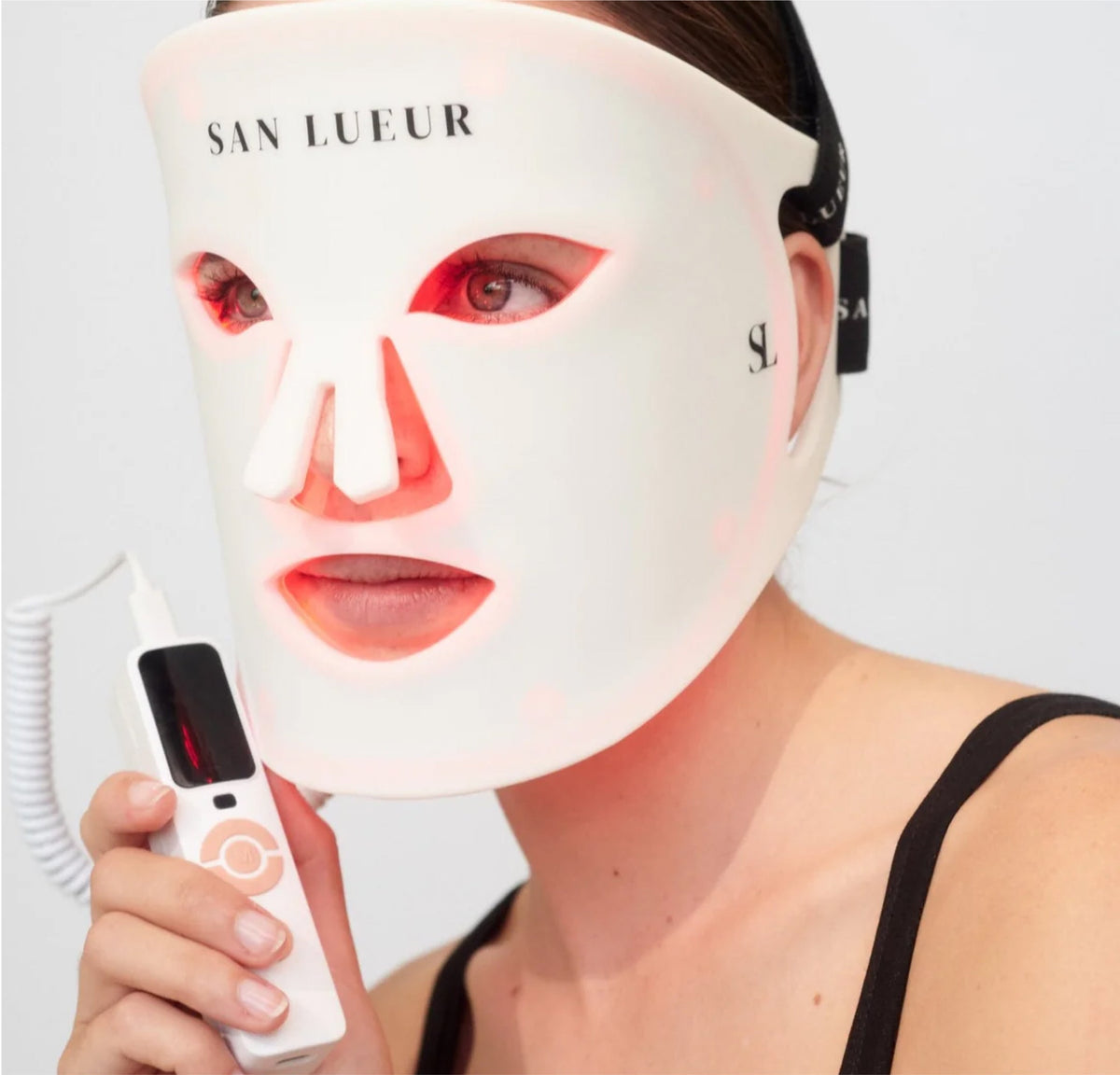
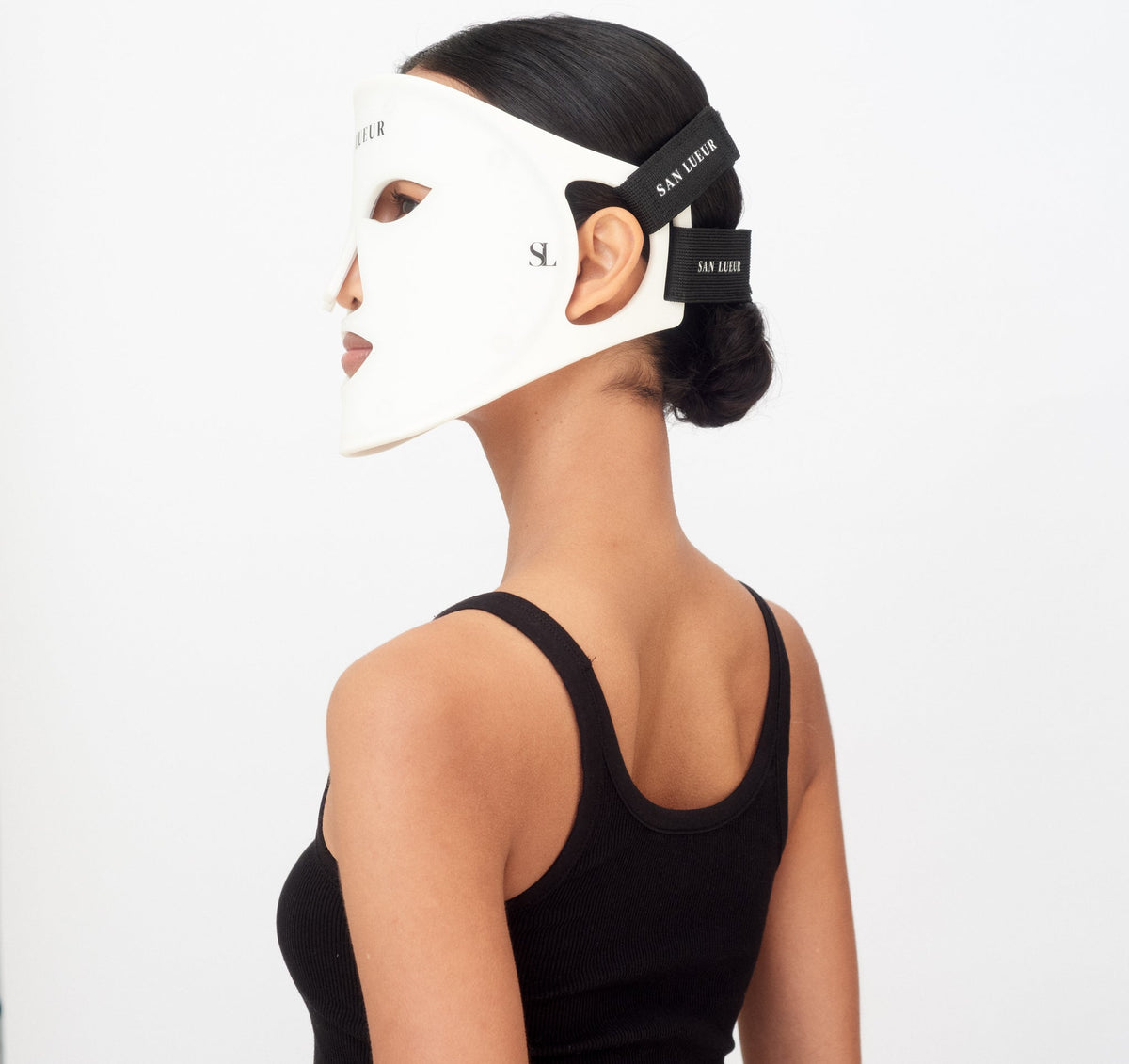
At SAN LUEUR we prefer to follow the science rather than the trend. That is why our device is built around three clinically studied wavelengths, blue, red and near-infrared, chosen for the weight of evidence behind them and the depths at which they work.
How does LED light therapy work on the skin?
LED light therapy rests on a simple principle. Different colours of light carry different wavelengths, and wavelength determines how deeply that light can travel into the skin. Shorter wavelengths, such as blue and green, stay closer to the surface. Longer wavelengths, such as red and near-infrared, reach the deeper layers where much of the skin's structural work takes place.
This matters because the qualities we associate with healthy-looking skin such as firmness, evenness and a smooth surface, are largely governed by what happens beneath the very top layer. A wavelength that cannot reach those depths has less opportunity to influence them.
What is green light supposed to do?
Green light usually sits around the middle of the visible spectrum, with a wavelength shorter than red. Because it does not penetrate as deeply, it is often marketed for concerns that live nearer the surface, with pigmentation and uneven tone chief among them. The theory is appealing. If pigment gathers in the upper layers, a wavelength that concentrates there might help to calm its appearance.
The reality is more measured. While green light is gentle and pleasant to use, the body of independent research supporting its effect on pigmentation is comparatively thin, and much of what exists is small in scale. It may have a role to play, yet it has not earned the same confidence as the wavelengths with a longer track record.
"Green Light is superficially absorbed where pigment cells sit, the human evidence for benefit is weak, and companies often borrow data from 532 nm lasers - a completely different high-energy technology - and pin it on a gentle LED."
Dr Prasanthi Purusothaman,
GP cosmetic physician and founder of L'Orient.
What does the research actually show?
When you look across the more robust studies, red light, at the specific wavelength of 633nm, and near-infrared light at the specific wavelength of 830nm, significantly stand out. Near-infrared in particular, which sits just beyond visible red, reaches the deepest and is the wavelength most associated with supporting the skin's underlying structure and the look of firmness over time. Red light is well studied for its association with a smoother, more radiant appearance, and blue light has a long history in the context of clarity and blemish-prone skin.
Green and amber, by contrast, have far less evidence to lean on. This is not to dismiss them, only to be honest about where the evidence currently sits. For a device you invite into your routine several times a week, that distinction is worth understanding before you spend.
Where does amber light fit in?
Amber light carries a wavelength between green and red. It is often promoted for soothing the look of redness and supporting a calm, comfortable complexion. As with green, the marketing tends to run ahead of the published science. There is nothing unpleasant about amber light, and some people genuinely enjoy it, yet it would be misleading to place it alongside near-infrared in terms of demonstrated benefits.
"Some masks now have amber or yellow light, which has earlier evidence for reducing redness and supporting lympthatic function, though the research base is smaller than for red, NIR or blue."
Kiki Abouchakra,
Dermal therapist and founder of Chakra Intelligent Skin.
What each wavelength is associated with
Set side by side, the wavelengths tell a clearer story:
- Blue light, a shorter wavelength, associated with the appearance of clearer, more balanced skin.
- Green light, a shorter wavelength, theorised to help the look of pigmentation, though the evidence remains limited.
- Amber light, a mid wavelength, promoted for the appearance of calm, with only modest supporting research.
- Red light, a longer wavelength, well studied for a smoother and more radiant-looking complexion.
- Near-infrared, the longest wavelength of the group, reaching deepest and most associated with the look of firmness and resilience.
Why SAN LUEUR very specifically chose blue, red and near-infrared wavelengths of light
Our decision was guided by two questions:
- Which wavelengths have the strongest evidence and that are used clinically and,
- Which wavelengths reach the depths where visible change is shaped? Blue, red and near-infrared answered both. Rather than crowd the device with multiple colours that may look impressive, we focused on the three that independent research supports, delivered at a high, optimised output for an at-home device, which significantly make it impressive.
The result is a considered tool rather than a novelty. Used consistently, it becomes a quiet fixture of an evening routine, a few still minutes that ask very little and offer a sense of ritual in return.
How do you choose an LED device with confidence?
If you are weighing up a device, a handful of questions will serve you well:
- Which wavelengths does it use, and are these wavelengths very precise are they supported by independent research?
- What is the energy output, and is it strong enough to be meaningful at home?
- Does the device focus purely focus on the number of lights used?
- What is the irradiance and is it strong enough to be meaningful at home? The irradiance is also one of the most significant parameters to look out for.
- Does it cover the areas you care about evenly and comfortably?
- Is it pleasant enough that you will genuinely reach for it several times a week?
- Does the brand explain its choices, or simply list as many colours as possible?
The final point is telling: devices that focus on a longer list of colours of lights as well as devices that focus on marketing a higher number of light bulbs while their wavelengths are not clinically backed and while their irradiance is very low, means the device is not meaningful enough to use at home. Think about these devices as just lights sitting on your face, without addressing any of your skin concerns or beauty outcomes. Understanding why certain wavelengths were chosen reveals far more than counting how many are included.
Making light part of a wider ritual
Light is only one thread in the fabric of skin that looks well. Sleep, hydration and the way you wind down each evening all play their part. Many people find that a short session with an LED mask sits beautifully at the close of the day, a signal to slow down before sleep. Paired with the calm of a considered evening and the quiet connection between rest and radiance, it becomes part of something larger than any single step.
The SAN LUEUR perspective
We believe in beauty guided by evidence and expressed with restraint. Green and amber light may yet earn a firmer place in the science, and we will follow that research with interest. For now, our commitment is to the wavelengths that have proven themselves, blue at the wavelength of 415nm, red at the wavelength of 633nm, and near-infrared at the wavelength of 830nm, offered with honesty about what they can and cannot do. That is the standard we hold ourselves to, and the one we believe you deserve.