Few ingredient groups in skincare inspire as much respect and confusion as retinoids. They are often described as the gold standard for rejuvenation, collagen support, blemish or acne management, and long‑term skin health. Yet questions persist: What’s the difference between retinol and retinal? Is prescription-strength always better? How do you choose the right retinoid for your skin without irritation?
Understanding how these vitamin A derivatives work and how they differ is essential for using them effectively. Because while retinoids are powerful, precision is what makes them transformative. Consider this your essential guide to retinoids, designed to help reduce the overwhelm and replace it with clarity.
First, What Are Retinoids?
‘Retinoid’ is an umbrella term for vitamin A derivatives used in skincare and dermatology. When applied to the skin, most retinoids (except tretinoin) undergoes one or more conversion steps to create retinoic acid. This is the biologically active form that interacts with skin cell receptors.
Retinoic acid is known for helping with:
- Accelerating dead skin cell turnover,
- Supporting collagen and elastin production,
- Improving the look of uneven skin tone and texture,
- Reducing the appearance of congestion and blemishes.
The key difference between retinoids lies in how many conversion steps are required before they become retinoic acid. This also relates to how potent, fast-acting, or irritating they may be as a result.
Before You Commit to Retinoids…
They come with some important caveats. The benefits of using retinoids are supported by decades of clinical research, however, they aren’t quick fixes.
Depending on the type of retinoid, its strength, and how it’s formulated, it typically takes at least three months to start experiencing noticeable rejuvenation effects. Retinoids also should be used consistently to build and maintain results – an on-off relationship won’t work well. (Note: retinoids are generally not recommended during pregnancy.)
Additionally, when introducing a retinoid into a skincare routine, or increasing to a higher strength, it’s common for people to experience less desirable effects like:
- Dryness and/or dehydration,
- Visible redness and/or flaking,
- Sensitivity and/or irritation,
- Impacting skin barrier function,
- Increased sensitivity to sun exposure,
- Breakouts or ‘purging’, particularly during the early stages of retinoid use.
These impacts are typically more noticeable where the skin is thinnest or most sensitive, such as around the nose or mouth. However, selecting the appropriate retinoid for your needs (and tweaking your routine if necessary) may help to minimise these effects.
The Retinoid Spectrum: From Gentle to Prescription-Strength
One of the most common misconceptions is that ‘retinoid’, ‘retinol’, and ‘retinal’ are interchangeable terms. Understanding the distinctions between them empowers more informed product choices and helps avoid misaligned expectations.
- Retinoids = the entire vitamin A family.
- Retinol = one type of over-the-counter retinoid,
- Retinal = another type of over-the-counter retinoid,
- Prescription options = retinoids that require a doctor’s prescription to purchase, as they are medications.
Furthermore, not all retinoids are created equal. Here’s how the most common forms compare.
Retinol: The Gateway Retinoid
Retinol is the most widely recognised over‑the‑counter retinoid, and often the entry point for beginners.
Once applied, retinol must undergo two conversion steps:
- Retinol → retinaldehyde (retinal)
- Retinal → retinoic acid
This gradual conversion process makes retinol effective while remaining relatively gentle, especially when introduced into a routine slowly.
Retinol works best when applied consistently over time. This slow-build approach aligns with modern skin health philosophies that prioritise barrier integrity and longevity. Start by using it every two or three evenings for the first week or two, depending on how your skin tolerates it. Gradually increase usage up to once per evening over the following weeks, if suitable.
Why retinol remains a staple:
- Supported by decades of clinical research,
- Widely tolerated when introduced slowly,
- A suitable option for those with sensitivity-prone skin,
- Helps improve the look of early fine lines, uneven texture, and mild hyperpigmentation,
- May assist with reducing the intensity of breakouts.
Retinal (Retinaldehyde): Precision and Performance
On the retinoid scale, retinal sits closer to retinoic acid than retinol. It only undergoes one conversion step to become retinoic acid, meaning it may help visible results appear sooner. However, there’s a trade-off: these benefits often occur in tandem with an increased chance of irritation compared to retinol.
Retinal can be particularly beneficial for ongoing skin concerns like breakouts and acne, uneven skin tone and texture, and chronological ageing. It appeals to users who want noticeable results without moving directly to prescription options. Like retinol, it’s essential to introduce retinal into your routine slowly and carefully.
What makes retinal distinctive:
- More potent and faster-acting than retinol,
- Associated with antibacterial activity, making it suitable for blemish-prone skin,
- Often stabilised in encapsulated or lipid-based systems to help reduce irritation.
Topical, Prescription-Grade Retinoids: The Next Step
Adapalene, tazarotene, tretinoin, and trifarotene are examples of medically prescribed topical retinoids. Often selected for acne, hyperpigmentation, and photoageing indications, the effectiveness of prescription retinoids is well-documented in dermatological literature.
They interact directly with retinoid receptors within the skin to deliver impactful results. However, because they’re significantly more potent than over-the-counter options, the potential for irritation is also much higher.
Potential benefits of prescription retinoids:
- Direct interaction with retinoid receptors,
- Visible improvement in acne and texture,
- Associated with skin smoothness and firmness.
Considerations:
- Must be prescribed by a doctor,
- May cause irritation during the retinisation phase,
- Requires strict sun protection,
- Must be used consistently.
Prescription retinoids are designed to be part of a broader skin health treatment plan, including steps to help counteract possible side effects. While they can be very effective, they mightn’t be the most appropriate choice for everyone, especially those with sensitive skin or a compromised barrier.
Choosing the Right Retinoid for Your Skin
The “best” retinoid is not about strength, it’s about appropriateness.
Consider retinol if:
- You’re new to retinoids,
- You want to slowly build up to long-term benefits,
- Your skin is sensitive or reactive.
Consider retinal if:
- You’re experienced with retinoids,
- You want noticeable results faster (and can handle potential irritation),
- You’re targeting adult acne or uneven texture.
Consider prescription retinoids if:
- You’re under professional medical supervision,
- Your acne or pigmentation is severe or persistent,
- You’re committed to ongoing barrier support and sun protection.
Using Retinoids Correctly: Less Is More
Skin health is cumulative and consistent. A well-tolerated retinoid used properly is likely to outperform intermittent, overly aggressive use.
Best practices:
- Start with two or three nights per week and gradually increase use to daily if tolerated,
- Apply to clean, completely dry skin at night only,
- Use a pea-sized amount for the full face (excluding around the eyes, unless specifically formulated for this area),
- Support with moisturiser and meticulous daily sun protection,
- Reduce use of other chemical and/or manual exfoliation products, if needed.
Retinoids reward patience. The goal is resilient, luminous skin over time with ongoing structural support - not rapid exfoliation.
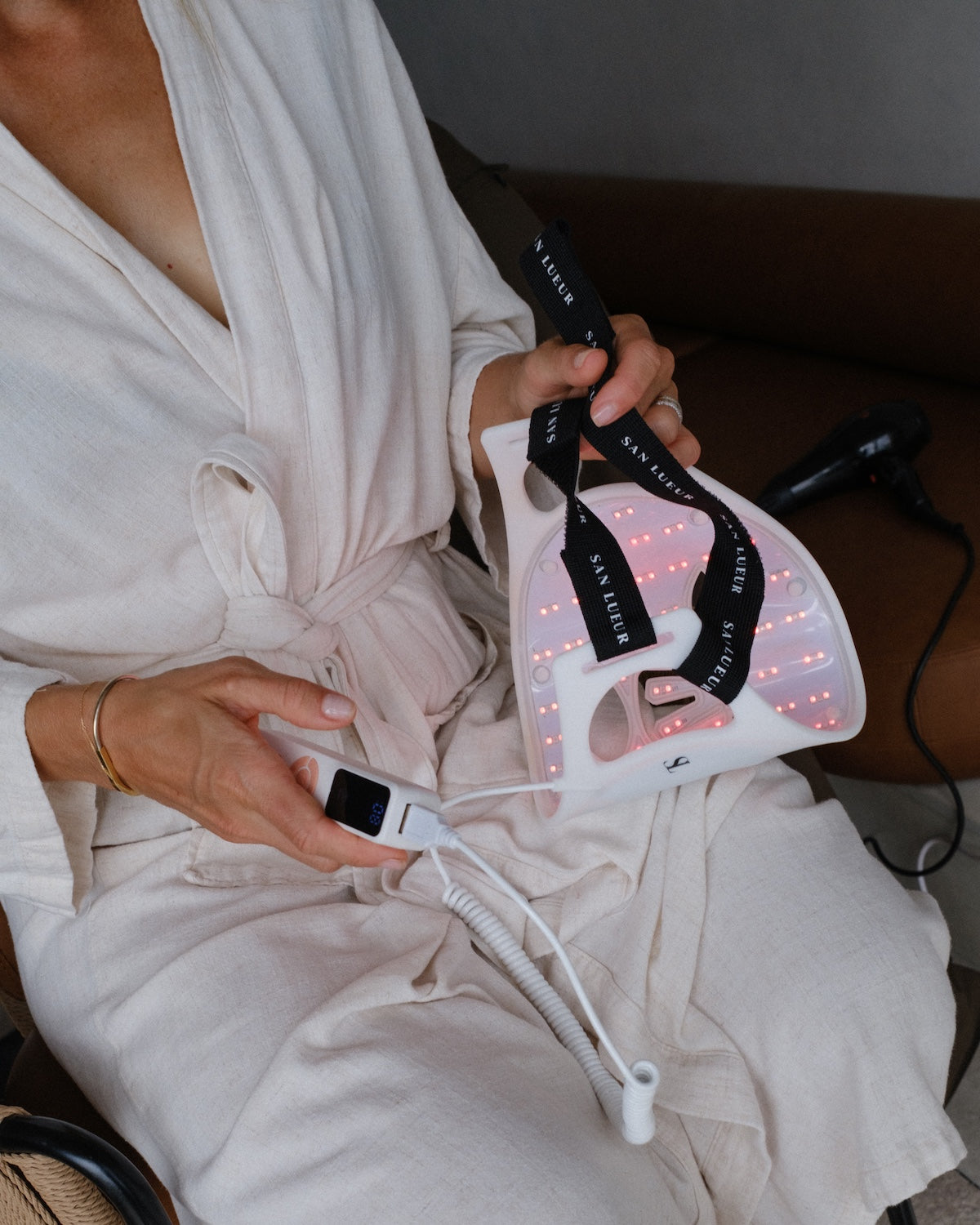
How LED Light Therapy Complements Retinoids
One of the most sophisticated evolutions in modern skincare is the integration of retinoids with LED light therapy.
While retinoids work at the cellular renewal level, LED therapy supports:
- Reduce the look of visible redness and inflammation,
- Support skin barrier function,
- Contribute to collagen production and noticeable skin rejuvenation.
Red and near-infrared light in particular may help counteract some effects during the retinoid introduction phase, by helping to calm the skin, support healing, and strengthen the skin barrier, making retinoid use more sustainable long-term. This synergy reflects a shift away from “push through irritation” approaches toward intelligent, more supportive skincare systems.
Why Retinoids Are Timeless, Not Trend‑Driven
Trends come and go. Retinoids endure. Not because they promise instant transformation, but because they work in alignment with skin biology. They encourage skin cells to renew more rapidly, produce new collagen and elastin, and function in an optimal state for ongoing skin health.
When paired with non-invasive technologies, barrier-supportive care, and intentional routines, retinoids become less about correction and more about longevity.
Final Thoughts
Retinol, retinal, and prescription retinoids are effective skincare options with distinct benefit and consideration profiles. Understanding the retinoid spectrum allows for smarter choices, improved tolerance, and more meaningful results. When used with respect for the skin’s natural rhythms and supported by advanced technologies, retinoids remain one of the most valuable investments in long-term skin health.
At SAN LUEUR, we believe great skincare is not about intensity, it’s about intention. And when it comes to retinoids, intention changes everything.